

Dubai launches driverless taxi operations as Sheikh Hamdan unveils autonomous fleet
First large-scale smart fleet to begin service next month
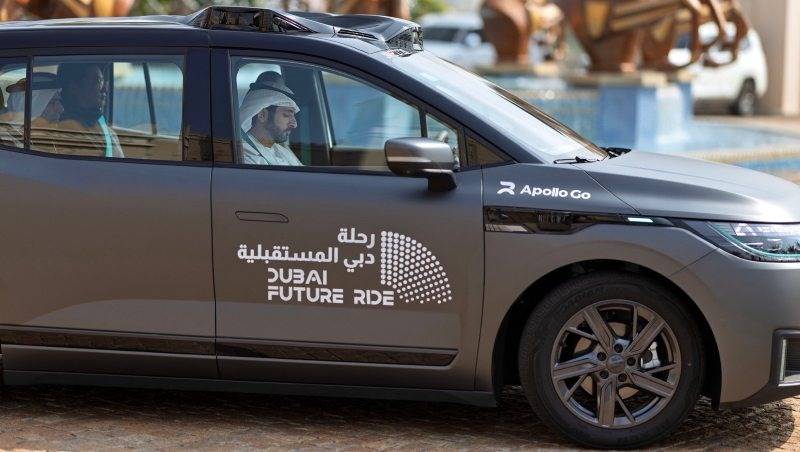
DUBAI – Dubai has moved a step closer to next-generation transport with the official launch of fully autonomous taxi operations led by His Highness Sheikh Hamdan bin Mohammed bin Rashid Al Maktoum.
The Crown Prince of Dubai announced the rollout after personally riding in a driverless vehicle on his way to the World Governments Summit 2026 at Madinat Jumeirah. The initiative forms part of the emirate’s wider smart mobility strategy built around artificial intelligence, automation and sustainable urban transport. Authorities confirmed that public service using the new autonomous taxi fleet will begin next month with 100 vehicles.
Hamdan bin Mohammed launches official operations of driverless taxi service in Dubai. @rta_dubai pic.twitter.com/vTczzMXYW5
— Dubai Media Office (@DXBMediaOffice) February 5, 2026
His Highness Sheikh Hamdan, who is also Deputy Prime Minister, Minister of Defence, and Chairman of The Executive Council of Dubai, directed the official start of operations for the driverless taxis developed under the RT6 model by Baidu Apollo Go. The deployment marks a practical expansion of Dubai’s long-term vision to integrate advanced mobility solutions into daily transport networks.
Summit ride
The Crown Prince travelled in one of the fully autonomous taxis to the World Governments Summit venue, describing the experience as a preview of Dubai’s mobility future driven by artificial intelligence, advanced sensing systems and automated decision-making. He stated that upcoming transport systems across the city will focus on safety, efficiency, inclusiveness and sustainability, supported by smart infrastructure and digital ecosystems.
Hamdan bin Mohammed launches the official operations of fully autonomous RT6 taxi vehicles developed by Baidu Apollo Go, as part of Dubai’s smart mobility ecosystem. His Highness took a ride in the autonomous vehicle to the venue of the World Governments Summit at Madinat… pic.twitter.com/niTfJWYM4X
— Dubai Media Office (@DXBMediaOffice) February 5, 2026
During the journey, he received a technical briefing on how the autonomous vehicle operates in live traffic conditions. Officials said the system combines AI computing, real-time data processing and layered sensing technologies to enable safe navigation without a human driver. The vehicle functions on open public roads and responds dynamically to surrounding traffic and pedestrians.
The launch event was attended by Omar Sultan Al Olama, Minister of State for Artificial Intelligence, Digital Economy and Remote Work Applications, and Mattar Al Tayer, Director-General and Chairman of the Board of Executive Directors of the Roads and Transport Authority.
Dubai driverless taxi
The deployed model represents the sixth generation of autonomous taxi vehicles designed specifically for scalable urban mobility services. Each unit is equipped with more than 40 sensors, including high-precision LiDAR units, multi-band radar systems and advanced optical cameras. Together, these components create a continuous 360-degree environmental awareness layer around the vehicle.

The sensing stack allows the taxi to detect lane movement, traffic signals, road edges, vehicles and pedestrians, while adjusting its behaviour in real time. Officials said the onboard systems are aligned with approved transport safety standards and are engineered for complex city conditions.
The operating platform runs on an advanced software ecosystem that merges high-definition mapping, live data feeds and deep-learning algorithms. This setup supports route planning, intersection handling and behavioural prediction for nearby road users. The system is also programmed to comply fully with traffic regulations and road rules.
According to project data, the operator’s autonomous fleet has already completed more than 150 million kilometres of safe driving globally and carried out over 10 million autonomous trips across multiple cities. These figures were cited as part of the operational maturity behind the Dubai deployment.
Global partnership
The driverless taxi programme is the result of cooperation between Dubai’s Roads and Transport Authority and Baidu Apollo Go. The partnership discussions began during the World Governments Summit 2025, where both sides reviewed international autonomous mobility models and explored regulatory and technical cooperation.
Following that meeting, progress moved quickly from framework discussions to field trials. A Memorandum of Understanding was signed, and pilot operations began on selected roads across Dubai. Authorities said the transition from planning to on-road implementation took around 10 months, supported by regulatory readiness and coordinated approvals.
Officials linked the pace of deployment to Dubai’s smart transport framework and streamlined decision-making processes, which enabled testing, validation and operational clearance within a short period.
Control centre
As part of the rollout, Baidu Apollo Go established its first autonomous vehicle operations and control centre outside China in Dubai. The facility is located in Dubai Science Park and covers 2,000 square metres. It serves as a central hub for fleet management, system monitoring and operational control.
The centre includes a command and control unit, simulation and training rooms, plus maintenance and inspection facilities. It supports continuous vehicle performance tracking, software updates and technical servicing. Teams at the site also conduct safety simulations and response planning linked to live operational data.
The control hub connects vehicle systems with smart road infrastructure and central decision platforms, enabling coordinated oversight as the fleet expands. Plans are in place to grow the autonomous taxi fleet in Dubai to more than 1,000 vehicles over the coming years. The deployment adds a new layer to Dubai’s smart mobility ecosystem through AI-driven transport, integrated infrastructure and international technology partnerships, with autonomous taxis now entering staged operational service across the emirate.